-
Mobile Version
Scan with Mobile
- Member Center
High vacuum chamber
A vacuum chamber is a container that maintains a vacuum state inside, and the production of a vacuum chamber should consider volume, material, and shape. Stainless steel is currently the main structural material for ultra-high vacuum systems. It has excellent corrosion resistance, low gas release rate, non-magnetic, good weldability, low conductivity and thermal conductivity, and can work at -270~900 ℃. It is widely used in high vacuum and ultra-high vacuum systems.
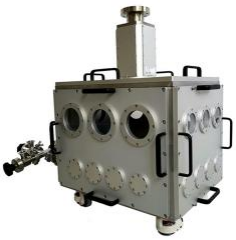
In recent years, in order to reduce the production cost of vacuum chambers, the use of cast aluminum alloy to make chambers has gradually become popular. In addition, there are also many examples of using titanium alloy to make special purpose vacuum chambers.
In order to reduce the surface area of the inner wall of the cavity, sandblasting or electrolytic polishing are usually used to obtain a flat surface. The chambers of ultra-high vacuum systems are mostly surface treated using electrolytic polishing.
Welding is one of the important processes in the production of vacuum chambers. To avoid chemical reactions between molten metal and oxygen in the atmosphere that may affect welding quality, argon arc welding is commonly used for welding. Argon arc welding refers to spraying protective gas argon around the tungsten electrode during the welding process to prevent oxidation reactions of the melted high-temperature metal. The argon arc welding of ultra-high vacuum chambers must generally use internal welding, that is, the welding surface is on the vacuum side to avoid virtual leakage.
The inner wall surface of the vacuum chamber adsorbs a large amount of gas molecules or other organic substances, becoming a source of gas release that affects the vacuum degree. To achieve ultra-high vacuum, the chamber needs to be baked at a high temperature of 150-250 ℃ to promote the rapid release of gas on the surface and inside of the material. The baking methods include wrapping heating tape around the outer wall of the cavity, fixing armored heating wires on the outer wall of the cavity, or directly placing the cavity in a baking tent. A relatively economical and simple baking method is to use a heating belt, which is wrapped with aluminum foil to prevent heat loss and evenly heat the cavity.
Our company has professional vacuum chamber design and manufacturing technology, which manufactures chambers according to the high requirements of industrial and research centers for high vacuum and ultra-high vacuum processes or academic research equipment.